Frederick Fiddaman (1856 - 1876)
Trinity School, Old Stratford, Northamptonshire
James Fiddaman and Jemima had three children. Ann Elizabeth was born in January 1854 and died in the February. James was born in February 1855 and lived only a few months. They must have rejoiced when Frederick was born in April 1856 and survived into his teenage years.
In 1871 Frederick was one of 38 boarders aged between 9 and 17 at Trinity School, Old Stratford, Northamptonshire, a middle-class school for boys, open for annual examinations. The principal was Rev. James Thomas, whose father John had founded the school around 1850, and who lived at the school with his wife Mary and six children. He ran it with two assistant masters, a cook, a nurse and two domestic servants. Frederick was the only pupil born in Norfolk and we can find no obvious link with any of James Fiddaman's friends. However James raced his horses at Northampton, Warwick and Bedford in the early 1860s. Race results were carried in several local papers in which Trinity School was advertised, such as the Northampton Mercury. While staying in the area for one of those race meetings it's probable that James saw one of these adverts and was attracted by its offering of 'a good Middle-Class Education, with careful moral training'. Fees for board and instruction were 22 Guineas a year; washing was 2 Guineas extra.
By this time the railways had revolutionised travel and Frederick would have been able to reach the school using trains from Lynn via Ely, Peterborough and Northampton to Wolverton from which Old Stratford was a short distance by horse or carriage.
Life and death on the ocean wave
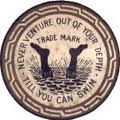 We still don't know why this son of a successful tradesman went to sea. Perhaps it was his father's idea of a gap year to see the world before he came back to help run the family business. We don't know who found him a berth on the ss Ionia although it could have been his father's friend James Bowker who as a young man had served as purser on South African mail steamers operated by Royal Mail Steamship Co and who in later life counted ship owner and ship broker amongst his many activities. Frederick's familiarity with his father's hotel and catering business with John J Lowe probably explains why he served as an engineers' steward. Unfortunately he drowned when the vessel was lost with all hands in the Bay of Biscay in 1876. His father would surely have been reminded of his loss every time he thought of his trade mark, which carried the old English proverb "Never venture out of your depth till you can swim". More information on the wreck of the Ionia is in our book Glimpses of Fiddaman's Lynn.
Officers & crew of the ss Ionia
[Reported in The Times Monday 30 October 1876.]
The following is a list of her crew as furnished by our correspondent at Sunderland. They signed articles in London for the Tyne, thence to Alexandria and Black Sea, and Sea of Asof etc, and back to the UK, for nine month:
- Charles Hyde, master of London [Served on the Ionia as 1st Mate since 1872 and qualified as Master in 1874.]
- J.C. Sibbald, chief mate, of South Shields
- John Roach, second mate, of Sunderland
- Edward Powell, third mate, of Sunderland
- William Welch, carpenter, of Sunderland
- Robert Stewart, steward, of London
- William Cramp, cook, of London
- Robert Nelson, boatswain, of Boston
- Thomas Rowntree, A.B., of London
- Edward Young, A.B., of London
- Richard Harvey, A.B., of London
- John Clark, A.B., of London
- William Judd, A.B., of Essex
- Herbert Palton, A.B., of Redcoat
- Thomas Billington, A.B., of London
- William Forward, A.B., of Saltfleet
- Joseph Cottle, first engineer, of London
- John Pattison, second engineer, of Carlisle
- Henry Williams, third engineer, of Sunderland
- James Hill, donkeyman, of Monaghan
- A. Wallace, fireman, of Dublin
- William Wheeler, fireman, of London
- James Cory, fireman, of Cornwall
- W. Barnard, fireman, of London
- H. Theile, fireman, of Hanover
- F. Fiddaman, engineer's steward, of Lynn
- Andrew Anderson, carpenter, of Sweden
- William Gardner, assistant carpenter, of South wick