Paul Henry ROCHARD (1883-1940)
Grandchildren's other roots & branches ©2010-2017 Rosemary & Stan Rodliffe

Before the Great War (1883-1917)
Paul Henry ROCHARD was born at Newport, Monmouthshire in 1883, the eldest of three children born to Pierre ROCHARD and Rose STEED.
At 18 years of age he was working as a clerk in his father's shipping office but he had longed to play the organ since he was seven years old when he had listened to it being played at services in St Mark's Church. He trained under Signor CIFONELLI at the Lycée du Havre in France and for four years was a pupil of Dr G.R. SINCLAIR at Hereford Cathedral. He was also trained to teach at the Matthay Pianoforte School in London. Eventually his qualifications included LRAM, ATCL, ARCM and ARCO - all highly regarded and suggesting that he was at the top of his profession as an organist.
He was organist and choirmaster at St Peter's Hereford when he married May BURDEN at Hereford in 1905. He moved to South Shields in Durham the following year where he was organist and choirmaster at St Aiden's and then Holy Trinity. His first child, Nina, was born here in 1906. In 1907 Paul was appointed organist and choirmaster at Hinckley Parish Church in Leicestershire where he was also music master at the Grammar School. His family would live at Hinckley for the next 12 years. Son Paul was born in 1912, daughter Cecily in 1916 and another son John (your great grandfather) in 1919.
World War 1 began in 1914 and it was to take Paul away from his family and Hinckley for months at a time.
Training to pilot kite balloons (1917-18)
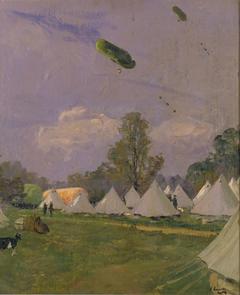
Paul enlisted in the Royal Naval Air Service (RNAS) in September 1917. He was specially trained for sea work in kite balloons at RNAS Roehampton (illustrated in the painting). He lived in a tent and would have spent most of his time learning how to manage a hydrogen filled kite balloon which was tethered to the ground by a cable and flown at heights up to 1000 metres or so. At this height the spotter could see to the horizon 60 miles away when visibility was good.

The pilot and observer had very little room in a basket that hung under the balloon. Paul was a flight lieutenant - like the one wearing the peaked cap - the pilot. (It's just possible but very unlikely that it's him in the picture). The other chap was the observer. It was very dangerous because enemy aircraft could attack you and the hydrogen could explode. They had parachutes in the bags on the side which they could use if things went wrong.
Service on HMS Campania (1918-19)
In March 1918 he was transferred to HMS Campania, once a famous Cunard steamship that had been launched in 1892 and bought by the Royal Navy in 1914 to convert into one of the first aircraft carriers. It carried seaplanes which could be launched down a ramp on the bows and a balloon which could be launched from the stern.

"HMS Campania 1" by Oscar Parkes - photograph SP 114 from the collections of the Imperial War Museums (collection no. 1900-01). Licensed under Public Domain via Wikimedia Commons.
Paul would not have seen much action because the ship was very unreliable and unable to keep up with the fleet when it put to sea. The war was at an end and Campania was transferred with the fleet from Scapa Flow to the Firth of Forth where she lay at anchor. On the morning of 5 November 1918 a sudden Force 10 squall caused the ship to drag anchor. She collided first with the bow of the nearby battleship Royal Oak, and then scraped along the side of the battlecruiser Glorious. Campania's hull was breached by the initial collision with Royal Oak, flooding her engine room and shutting off all main electrical power. The ship then started to settle by the stern, and sank some five hours after breaking free. The ship's crew was all rescued by neighbouring vessels.
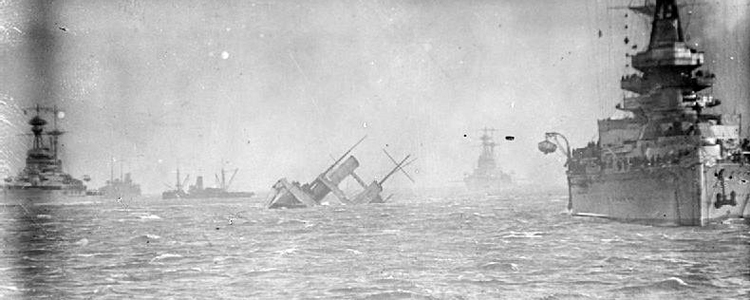
By Royal Navy official photographer [Public domain], via Wikimedia Commons
War ended six days later and Paul was assigned to ground duties before being transferred to the unemployed list in February 1919. He had joined the RNAS but became one of the first members of the RAF when it was created from amalgamation of the RNAS and Royal Flying Corps in April 1918. He received Victory and British War medals.
Music master, organist and choirmaster (1919-40)
Paul became organist at Kendal Parish Church and music master at Kendal Grammar School in 1919. Recitals became a feature of the musical life of Kendal over the next twelve years and he played piano for the rehearsals of Choral Society. By the time he left in 1931 he had given his 365th recital in the British Isles.
His next appointment was organist and choirmaster at Lancaster Priory and Parish Church. During this time he continued with his recitals many of which were broadcast on the radio. His health began to suffer and in 1938 Paul was suddenly taken ill during morning service. He continued playing the psalm with one hand and called upon fifteen year old ex-choirboy, Leslie GEORGE, to take his place. The boy played to the close of the service without anyone realising that he had taken over. Paul was taken home by another former choirboy where he recovered. He lived for two more years and died in 1940 having given over 430 recitals.
Views on society
Paul had strong views about fashion and popular music and occasionally took the opportunity to express them in the local newspaper.
He clearly did not like cosmetics!
"Twice a year I visit a large and fine city with which I was quite familiar when a youth. In those far off days I saw nothing grotesque, but today the painted figures, some like death masks, seated in the cafes surrounded by tobacco smoke, some without eyebrows, others with strange streaks of paint where eyebrows ought to be. I am lost in wonderment. We used to learn in schools the use of the eyebrows and believed they were to keep perspiration from the eyes, ..."[Lancashire Evening Post 6 July 1935]
Nor did he like Jazz!
"It is my sincere belief that our beautiful organ is superior to any group of saxophones, muted brass and drums. Crooners receive £10 a minute, and according to the daily newspapers America is paying £50,000 for a visit of a 'hot jazz band', but many who realise the folly of this ought to feel it a duty to support any effort that tries to produce real music ......." [Lancashire Evening Post 12 October 1935]