Able Seaman BLOMFIELD on the Cathaya
Great-grandfather Thomas William Blomfield (1849 - 1907) ©2013 Rosemary & Stan Rodliffe

Bound for Sydney Australia
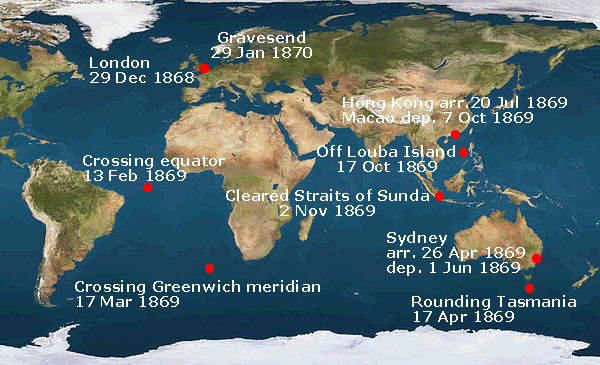
The Cathaya was a full-rigged ship built by Charles Lamport at Workington in December 1863. At 790 tons, length 178 feet and beam 32 feet she was somewhat smaller than the Cutty Sark (975 tons, length 212 feet, beam 36 feet and launched in 1869). She returned from Shanghai carrying tea and passed into customs on 26 November 1868. One month later, on 24 December, Thomas William joined the crew as able seaman and the ship, captained by James Paterson, sailed from London on 29 December 1868 arriving at Sydney, New South Wales on 26 April 1869. They carried a cargo of general merchandise and Herman Jackson was the sole passenger. The following is a description of the voyage from The Sydney Morning Herald [Monday 26 April 1869]:
"The ship Cathaya, Captain Paterson, arrived yesterday from London after a passage of 104 days, and although a vessel possessed of considerable speed, the very adverse winds she has had to contend against in the earlier portion of her run out precluded the possibility of making the ordinary passage. Captain PATERSON states that he left the Downs on the 8th January, and passed Start Point on the 10th January. He had very heavy S.W. gales after leaving the Channel, and very bad trades on both sides of the equator, which was crossed on the 13th February in longitude 27.10 W. The meridian of Greenwich was crossed on the 17th March, and he ran down his longitude on a parallel of latitude 45 S, carrying good W.N.W. winds to the South Cape of Tasmania, which was rounded on the 17th instant. Since then northerly winds have prevailed up to the 24th, when he had a heavy gale from the W.S.W. The Cathaya is in beautiful order, and is to the consignment of Messrs. Young, Lark and Co."
A list of the crew on arrival in Sydney is recorded at the Mariners and Ships in Australian Waters website.
Not without incident
The voyage was not without incident! On 16th January fourteen of the crew of the Clymene had refused to work because they claimed that their vessel was unseaworthy and there was 6 inches of water in their sleeping quarters due to the bad weather. They requested that their master, Captain MORGAN, put back but he refused. They were then boarded by Captain PATERSON of the Cathaya, whose crew came on board and assisted to reef the topsails. In Sydney on Thursday, 13th May 1869, following further refusals to obey orders, nine seamen belonging to the Clymene, were brought up on remand for wilful disobedience and were each sentenced to four weeks hard labour on the hulks and the loss of two days pay. It was not a one-sided story because Captain MORGAN was also prosecuted at the same hearing for failing to provide lime juice and failing to post a copy of the agreement between him and his crew in a prominent position. He was fined £5 for each offence. [Williamstown Chronicle, Saturday, May 15th, 1869]
The cargo
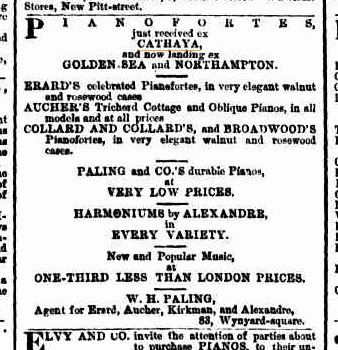
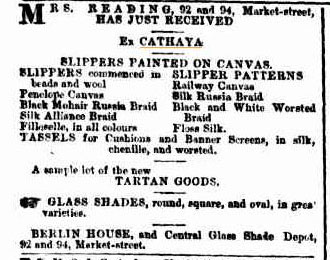
These advertisements from The Sydney Morning Herald illustrate the cargo that they had delivered.
Homeward bound via Canton
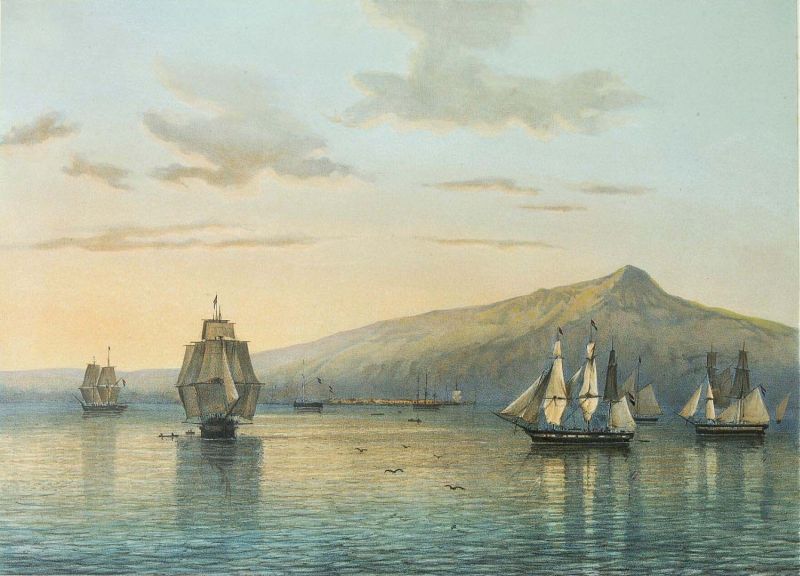
On 1st June 1869 the General Post Office announced in the Sydney Morning Herald that mail for Hong Kong would be taken by the Cathaya at noon if not already underway. They departed Circular Wharf that day carrying 1044 tons of coal and arrived at Hong Kong on 20th July. Then across the Zhujiang River Estuary to Macao seeking cargo for the return to London.
The London and China Telegraph reported the Cathaya at Canton loading 650,108 lbs of tea and expected to depart on 6th October. The southwest monsoon came late that year and by October should have been replaced by light winds, overcast skies and squally weather. The northeast monsoon would have been expected in November. Ten days out on October 17th they were spoken to off Louba Island - probably Lubang Island off the entrance to Manilla Bay on the west coast of the Philippines.
By 2nd November they had cleared the Straits of Sunda, which narrows to about 15 miles at Anjer Point, passing the lighthouse and telegraph station, then west to Madagascar, rounding the Cape of Good Hope into the Atlantic and northwards to home. They arrived at Gravesend 29th January 1870 [London Daily News, Monday 31 January 1870].